

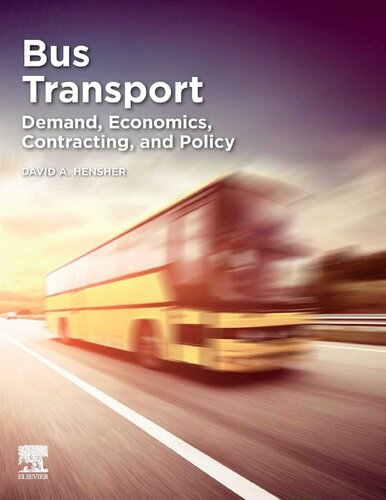
Bus Transportation Demand Economics Contracting and Policy 1st Edition by David Hensher 0128203934 9780128203934

Original price was: $50.00.$25.00Current price is: $25.00.
Bus Transportation: Demand, Economics, Contracting, and Policy 1st Edition by David A. Hensher – Ebook PDF Instant Download/DeliveryISBN: 0128203934, 9780128203934
Full download Bus Transportation: Demand, Economics, Contracting, and Policy 1st Edition after payment.
Product details:
ISBN-10 : 0128203934
ISBN-13 : 9780128203934
Author: David A. Hensher
Bus Transport: Demand, Economics, Contracting, and Policy examines in one source the most critical and current research themes of public transport relevant to regulators, planners, operators, researchers and educators. It highlights the wider economic impacts of public transport and compares energy usage across all public transport modes. The book examines the evolving debate on Mobility as a Service (MaaS) and includes discussion of such themes as; public image issues, performance measurement and monitoring, contract procurement and design models, travel choice and demand, and global public transport reform. The book reflects the leading perspectives on the preservation and health of the bus sector, intending to move public transport reform forward.
Bus Transportation: Demand, Economics, Contracting, and Policy 1st Table of contents:
Chapter 1. Introduction
Part I. Reviews
Chapter 2. Public service contracts in the bus sector
2.1. Introduction and background
2.2. Contract theory and risk
2.3. Efficient contracting
2.4. Why are performance-based contracts so rare?
2.5. An overview of contract regimes in passenger transport
2.6. Establishing a setting in which to compare the performance of operators
2.7. Conclusions
Chapter 3. Disruptive technology and moving people
3.1. Scope
3.2. Disruptive technological changes affecting land passenger transport
3.3. Assessing improvements in societal wellbeing
3.4. Some societal trends relevant to technological disruption in land passenger transport
3.5. Scenarios
3.6. Policy implications
Appendix 3.A
Chapter 4. The influence of the Thredbo series
Chapter 5. Competition and ownership in land passenger transport: the Thredbo story
5.1. Introduction
5.2. Market arbitration
5.3. Procurement mechanism
5.4. Asset ownership
5.5. Contract design
5.6. Risk allocation
5.7. Contract management
5.8. Looking to the future: the next 30 years
Part II. Contracting
Chapter 6. Contracting regimes for bus services: what have we learnt in recent years?
6.1. Background
6.2. Contract regimes: the case for negotiation
6.3. Contract completeness: why trust is fundamental
6.4. Building trust through partnership
6.5. Tactical level planning: the foundation for unleashing value for money
6.6. Conclusions
Chapter 7. Incompleteness and clarity in bus contracts
7.1. Introduction
7.2. A framework in which to identify contract incompleteness and clarity
7.3. Empirical application
7.4. Empirical analysis
7.5. Conclusions
Chapter 8. A simplified performance-linked value for money model for bus contract payments
8.1. Background
8.2. A proposed simplified performance-linked payment (SPLP) model
8.3. Establishing benchmark value for money outcomes
8.4. Using the benchmark value for money outcomes
8.5. Conclusions
Chapter 9. Bus contract costs, user perceived service quality and performance assessment∗
9.1. Introduction
9.2. Developing a service quality index
9.3. Results of the user preference model
9.4. The service quality index (SQI)
9.5. Linking service quality to cost and demand
9.6. The relationship between average cost per km and SQI
9.7. Determination of service performance standards and operator compliance
9.8. Conclusions
Chapter 10. Customer service quality and benchmarking in bus contracts
10.1. Introduction
10.2. Concerns about traditional likert scale metrics of customer satisfaction
10.3. Developing a customer service quality index
10.4. The user preference model results
10.5. The customer service quality index (CSQI) and benchmarking
10.6. Conclusions
Appendix
Chapter 11. Are there cost efficiency gains through competitive tendering or negotiated performance-based contracts and benchmarking in the absence of an incumbent public monopolist?
11.1. Introduction
11.2. A brief overview of negotiated performance-based contracts and competitive tendering
11.3. Approach to establishing benchmarked cost efficiency
11.4. A comparative assessment of NPBC and CT in Australia
11.5. Conclusions
Chapter 12. Efficient contracting and incentive agreements: the influence of risk preferences of contracting agents on contract choice
12.1. Introduction
12.2. Contract theory
12.3. Efficient contracting
12.4. Using choice experiments as a way of empirically investigating contract preferences
12.5. Designing the choice experiments for contract assessment
12.6. Conclusions
Appendix A. The experimental design of PT contract preferences
Chapter 13. Using contracted assets to undertake non-contracted services to improve cost efficiency
13.1. Introduction and background
13.2. A case study
13.3. Conclusions
Chapter 14. Disruption costs in bus contract transitions
14.1. Introduction
14.2. Accounting for reputational risk in the assessment of contracting offers
14.3. The mixed logit model
14.4. Development of the sample and the survey instrument
14.5. Descriptive profile of sample
14.6. Key findings
14.7. Conclusions and implications
Appendix 14.A: Background questions
Part III. Bus rapid transit
Chapter 15. Sustainable bus systems: moving towards a value for money and network-based approach and away from blind commitment
15.1. Introduction
15.2. The appeal of BRT
15.3. Conclusions
Appendix
Chapter 16. Ridership drivers of bus based transit systems
16.1. Introduction
16.2. Data
16.3. Methodology
16.4. Sources of systematic variation in BRT ridership
16.5. Conclusions
Appendix 16.A: descriptive statistics and correlation matrix for variables in Table 16.2
Appendix 16.B: random effects ridership regression model with GDP per capita and population density
Chapter 17. Performance contributors of bus rapid transit systems within the ITDP BRT standard
17.1. Introduction
17.2. The ITDP approach
17.3. The ordered choice model
17.4. Data
17.5. Revealed predictors of the BRT standard
17.6. Applications: business-as-usual projection and what-if analysis
17.7. Conclusions
Chapter 18. Review of bus rapid transit and branded bus service performance in Australia
18.1. The BRT debate: what happened?
18.2. An overview of BRT and BBS in Australia
18.3. Gross performance comparison
18.4. Rationale for normalisation
18.5. Net performance comparison
18.6. Discussions and conclusions
Appendix: included routes in each service cluster
Part IV. Image
Chapter 19. Identifying resident preferences for bus and rail investments
19.1. Introduction
19.2. Drivers of community preferences for public transport
19.3. Overview of the random regret mixed logit model
19.4. Empirical study
19.5. Model results
19.6. Application to project planning
19.7. Conclusions and synthesis
Chapter 20. Cultural contrasts of preferences for bus rapid transit and light rail transit
20.1. Introduction
20.2. Literature review
20.3. The choice experiment
20.4. The samples and sources
20.5. Descriptive profile of sample
20.6. The mode preference model form
20.7. Model results
20.8. Willingness to pay
20.9. Community preference model: simulated scenarios
20.10. Conclusions
Appendix 20.A
Part V. Elasticities
Chapter 21. Assessing sources of variation in public transport elasticities: some warnings
21.1. Introduction
21.2. The data source
21.3. The evidence
21.4. Conclusions
Appendix 21.A profile of data by elasticity type
Part VI. Crowding
Chapter 22. A review of willingness to pay evidence on public transport crowding
22.1. Introduction
22.2. Valuation of in-vehicle crowding
22.3. Valuation of crowding in access-ways and platforms
22.4. Synthesis of WTP estimates
22.5. Conclusions and policy implications
Chapter 23. A review of objective and subjective measures of crowding in public transport
23.1. Introduction
23.2. Measures of crowding
23.3. Monitored crowding vs. experienced crowding: evidence from Melbourne and Sydney
23.4. Subjective or psychological components of crowding
23.5. Linking subjective and objective measures to measurable users benefits for inclusion in benefit-cost analysis
23.6. Conclusions and recommendations
Appendix 23.A: Measuring subjective evaluations of crowding or perceived crowdedness (Mohd Mahudin et al., 2012)
Chapter 24. The effects of passenger crowding on public transport demand and supply
24.1. Introduction
24.2. Effects of passenger density and crowding
24.3. Estimation of crowding and standing costs
24.4. Effect of crowding disutility on demand estimation
24.5. Summary and conclusions
Chapter 25. Multimodal transport pricing with extensions to non-motorised transport
25.1. Introduction
25.2. Setting public transport fares: first best and second best models
25.3. Results that matter
25.4. A three-mode pricing model
25.5. Summary and conclusions
Appendix
Part VII. Transport appraisal
Chapter 26. Estimating the wider economic benefits of the Sydney North West Rail Link project
26.1. Introduction
26.2. Welfare benefits
26.3. GDP impacts
26.4. Case study – North West Rail Link
26.5. Concluding remarks
Chapter 27. Clarifying the complementary contributions of cost benefit analysis and economic impact analysis in public transport investment
27.1. Introduction
27.2. Requirements for decision support
27.3. Contrasting analysis methods
27.4. Matching analysis methods to the context of decisions
27.5. The bus rapid transit (BRT) case study and its evaluation process
27.6. Analysis results
27.7. Discussion
27.8. Conclusion
Chapter 28. How well does BRT perform in contrast to LRT? An Australian case study
28.1. Introduction
28.2. The context for MetroScan’s role
28.3. Case study: bus rapid transit and light rail transit
28.4. Benefit – cost and economic impact analyses
28.5. Economic impact analysis
28.6. Conclusions
Appendix
Part VIII. Energy
Chapter 29. Can bus be cleaner and greener than rail?
29.1. Introduction
29.2. Gathering the evidence on environmental advantage
29.3. The results of environmental advantage
29.4. Conclusions
Part-IX. Social exclusion
Chapter 30. The roles of mobility and bridging social capital in reducing social exclusion in regional Australia
30.1. Introduction
30.2. Some concepts and definitions
30.3. Key literature on regional mobility/accessibility and social exclusion
30.4. Data analysis
30.5. Discussion
30.6. Conclusions
Part X. Mobility as a Service (MaaS)
Chapter 31. Future bus transport contracts under a mobility as a service regime
31.1. Introduction
31.2. A brief overview of MaaS in practice
31.3. What might MaaS mean for future bus contracts?
31.4. Future service delivery options in the new digital age
31.5. Links to reducing traffic congestion and scalability
31.6. Conclusions
Chapter 32. Potential uptake and willingness-to-pay for mobility as a service
32.1. Introduction
32.2. Literature on MaaS
32.3. The choice experiment survey
32.4. Sampling and sample profile
32.5. Descriptive analysis and model specification
32.6. Estimation results and willingness-to-pay for MaaS
32.7. Conclusions and ongoing research
Chapter 33. Identifying broker/aggregator models for delivering mobility as a service
33.1. Introduction
33.2. Delivering mobility as a service
33.3. Methodology
33.4. Mobility contract design
33.5. The survey instrument
33.6. Preliminary results
33.7. Conclusion and next steps
Appendix
Chapter 34. What might road congestion look like in the future under a collaborative and connected mobility model?
34.1. Introduction
34.2. Smart shared mobility and potential implications for levels of congestion
34.3. The need for a governance framework to ensure smart mobility delivers congestion reduction
34.4. Data access and sharing – necessary to manage network congestion
34.5. Road pricing reform
34.6. Conclusions
People also search for Bus Transportation: Demand, Economics, Contracting, and Policy 1st:
public transportation economics
transportation economics definition
economic transportation
business economics (b.s.)
transportation economics
Tags: Bus Transportation, Demand, Economics, Contracting, Policy, David Hensher
You may also like…
Business & Economics
Business & Economics
Sustainability in Business: A Financial Economics Analysis 1st ed. Edition David Hobson Myers
Technique - Transport
Business & Economics Society
How to Write about Economics and Public Policy 1st Edition Katerina Petchko
Business & Economics

Biology and other natural sciences

Politics & Philosophy