

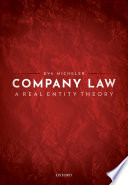
Company Law A Real Entity Theory 1st edition by Eva Micheler 0192602626 9780192602626


Original price was: $50.00.$25.00Current price is: $25.00.
Company Law: A Real Entity Theory 1st edition by Eva Micheler – Ebook PDF Instant Download/DeliveryISBN: 0192602626, 9780192602626
Full download Company Law: A Real Entity Theory 1st edition after payment.
Product details:
ISBN-10 : 0192602626
ISBN-13 : 9780192602626
Author: Eva Micheler
This book advances a real entity theory of company law, in which the company is a legal entity which acts autonomously in law, and company law establishes procedures facilitating autonomous organisational decision-making. The theory builds on the insight that organisations or firms are a social phenomenon outside of the law and that these are autonomous actors in their own right. They are more than the sum of the contributions of their participants and they act independently of the views and interests of their participants. This occurs because human beings change their behaviour when they act as members of a group or an organisation; in a group we tend to develop and conform to a shared standard, and when we act in organisations habits, routines, processes, and procedures form and a culture emerges. These take on a life of their own affecting the behaviour of the participants. Participants can affect organisational behaviour but this takes time and effort. Company law finds this phenomenon and supplies it with a structure supporting autonomous action by organisations. The real entity theory advanced in this book explains company law as it stands at a positive level. Legal personality overcomes the problems that organisations are social rather than brute facts and that there is no unique physical manifestation permanently associated with an organisation. The corporate constitution is not a contract – it is best characterised as an instrument adopted on a statutory basis through private action. Shareholders cannot limit the capacity of companies or the authority of the board to bind the company in contract and companies are liable in tort and crime. The statute creates roles for shareholders, directors, a company secretary, and auditors and so facilitates a process leading to organisational action. The law also integrates the interests of creditors and stakeholders.
Company Law: A Real Entity Theory 1st Table of contents:
1. A Real Entity Theory of Company Law
1.1 Introduction
1.2 Contract theory
1.2.1 Introduction
1.2.2 Nexus of contract and agency theory
1.2.3 Shareholders versus stakeholders
1.2.4 Evaluation
1.3 Concession theory
1.3.1 Introduction
1.3.2 Modern concession theory
Case law
Academic contributions
Evaluation
1.4 Real entity theory
1.4.1 Introduction
1.4.2 Shareholders versus stakeholders
1.4.3 Foundations of real entity theory
About facts
Natural, group, and organizational action
Institutional theory
Institutional theory in economics
Conclusions
1.4.4 Applying real entity theory to company law
1.4.5 Structure of the book
1.4.6 Shareholders versus stakeholders
2. Corporate Personality
2.1 Introduction
2.2 Legal personality for all lawful purposes
2.3 One-person companies
2.4 Corporate groups
2.5 Beginning and ending companies
2.6 Theoretical observations
3. Corporate Capacity
3.1 Introduction
3.2 Contract as explanation for the ultra vires doctrine
3.3 The collapse of the ultra vires doctrine
3.4 Corporate purpose
3.5 Theoretical observations
4. Limited Liability
4.1 Introduction
4.2 Veil piercing
4.2.1 Sham and facade
4.2.2 Evasion
4.2.3 Concealment
4.2.4 Theoretical observations
4.3 Personal liability for shareholders and directors
4.3.1 Fraud
4.3.2 Fraudulent trading
4.3.3 Wrongful trading
4.3.4 Phoenix companies
4.3.5 Disqualification of directors
4.3.6 Liability in tort
4.3.7 Theoretical observations
4.4 Applying statutes to companies
4.4.1 Statutes generally
4.4.2 Groups
4.4.3 Theoretical observations
4.5 Theoretical observations
5. Corporate Actions
5.1 Contract
5.2 Tort
5.3 Crime
5.3.1 Introduction
5.3.2 Identification doctrine
Introduction
Statutory offences
Common law crimes
5.3.3 Critique of the identification doctrine
5.3.4 Vicarious liability
5.3.5 Strict liability offences with due diligence defences
5.3.6 Organizational failure to prevent a crime
5.3.7 Deferred prosecution agreements and rehabilitation
5.3.8 Theoretical observations
5.4 Conclusions
6. The Organizational Framework
6.1 Introduction
6.2 The role of the statute
6.2.1 Introduction
6.2.2 Constitutional matters
6.2.3 Managing the company
6.2.4 Record-keeping and reporting
6.2.5 Procedures for shareholder decisions
6.2.6 Duomatic
6.2.7 Procedures for decisions of the directors
6.2.8 Conclusions
6.3 The role and nature of the constitution
6.3.1 Introduction
6.3.2 Misrepresentation, duress, and undue influence
6.3.3 Rectification
6.3.4 Mutual understanding of quasi-partners
6.3.5 Enforcement
Membership rights only
No ‘mere internal irregularities’
Theoretical observations
6.3.6 Conclusions
6.4 Conclusions
7. The Role of the Directors
7.1 Introduction
7.2 Duties are owed to the company
7.3 Duty to act in accordance with the company’s constitution and for a proper purpose
7.4 Duty to promote the success of the company
7.4.1 Introduction
7.4.2 Companies Act 2006, section 172
7.4.3 Conclusions
7.4.4 Theoretical observations
7.5 Duty to exercise independent judgement
7.6 Duty to exercise reasonable skill and care
7.6.1 Introduction
7.6.2 The early common law
7.6.3 The later common law and statutory intervention
7.6.4 Disqualification
7.6.5 UK Corporate Governance Code 2018
7.6.6 Conclusions
7.6.7 Theoretical observations
7.7 Duty to avoid a conflict of interest
7.7.1 Introduction
7.7.2 Companies Act 2006, section 175
7.7.3 Contrast with partnership law
7.7.4 Approval of interested transactions
7.7.5 Theoretical observations
7.8 Self-dealing
7.8.1 Introduction
7.8.2 Duty to declare an interest in proposed transactions or arrangements
7.8.3 Approval of self-dealing
7.8.4 Limits to shareholder approval
7.8.5 Conclusions
7.9 Remuneration
7.9.1 Introduction
7.9.2 Equity and the statutory regime
7.9.3 The role of shareholders
7.9.4 Conclusions
7.9.5 Theoretical observations
7.10 Duty to record and report
7.10.1 Introduction
7.10.2 Duty to keep accounting records
7.10.3 Duty to prepare annual accounts
7.10.4 Duty to prepare narrative reports
Introduction
Directors’ report
Strategic report
Separate corporate governance statement
Remuneration report
Conclusions and theoretical observations
7.10.5 Duty to have the accounts and reports verified
7.10.6 Duty to publicize accounts and reports
7.10.7 Reports on specific social and environmental matters
7.10.8 Sanctions
7.10.9 Conclusions and theoretical observations
7.11 Duty to abide by the statutory distribution rules
7.11.1 Introduction
7.11.2 No shareholder approval
7.11.3 Liability of the directors
7.11.4 Liability of the shareholders
7.12 Theoretical observations
8. The Role of the Shareholders
8.1 Introduction
8.2 Constitutional matters
8.2.1 Forming and ending the company
8.2.2 Power to amend the constitution
8.2.3 Power to appoint and remove directors
8.2.4 Directors are not agents of the shareholders
8.2.5 Power to appoint and remove auditors
8.3 Managing the company
8.3.1 Issuing shares
Introduction
Pre-emption rights
Valuations of contributions in kind
Issues at a discount
Conclusions
8.3.2 Takeovers
8.3.3 Approving transactions
Unfair prejudice
Disguised returns of capital
8.3.4 Ratification of breaches of duty by the directors
8.4 Accounting records and annual accounts
8.5 Distributions
8.6 Stewardship
8.7 Reflective loss
8.7.1 Introduction
8.7.2 Double recovery
8.7.3 Causation
8.7.4 Ease of settling claims
8.7.5 Protecting the autonomy of the company
8.7.6 Theoretical observations
8.8 Conclusions
9. Enforcement
9.1 Introduction
9.2 Private enforcement
9.2.1 Introduction
9.2.2 The supremacy of the corporate decision-making process—Foss v Harbottle
9.2.3 Fraud and wrongdoer control
9.2.4 Ultra vires and illegality
9.2.5 Special resolutions
9.2.6 The statutory regime
9.2.7 Stage one
9.2.8 Stage two—permission must be refused
Authorization or ratification by the company
Person acting in accordance with section 172
9.2.9 Stage two—discretion of the court
Whether the member is acting in good faith in seeking to continue the claim
Likelihood of authorization/ratification
Decision of the company to not to pursue the claim
Cause of action of the member in his own right
Views of members without a personal interest
9.2.10 Stage two—no prescribed standard of proof
9.2.11 Limited permission to continue
9.2.12 Indemnity for cost
9.2.13 Theoretical observations
9.3 Public enforcement
10. Stakeholders
11. Conclusions
People also search for Company Law: A Real Entity Theory 1st:
real entity theory
real entity theory corporation
company law – a real entity theory
a legal entity with authority to act
c corporation real estate
Tags: Company Law, Real Entity, Theory, Eva Micheler
You may also like…

Science Fiction - Fantasy Fiction

Politics & Philosophy - Social Sciences

Uncategorized
Business & Economics

Romance - Contemporary Romance
Secrets of a Billionaire Billionaire Kings Book 3 1st edition by Eva Winners B0C6357LXW

Commercial & Financial Law

Romance - Contemporary Romance

Business & Economics - Real Estate
Languages - Dictionaries