

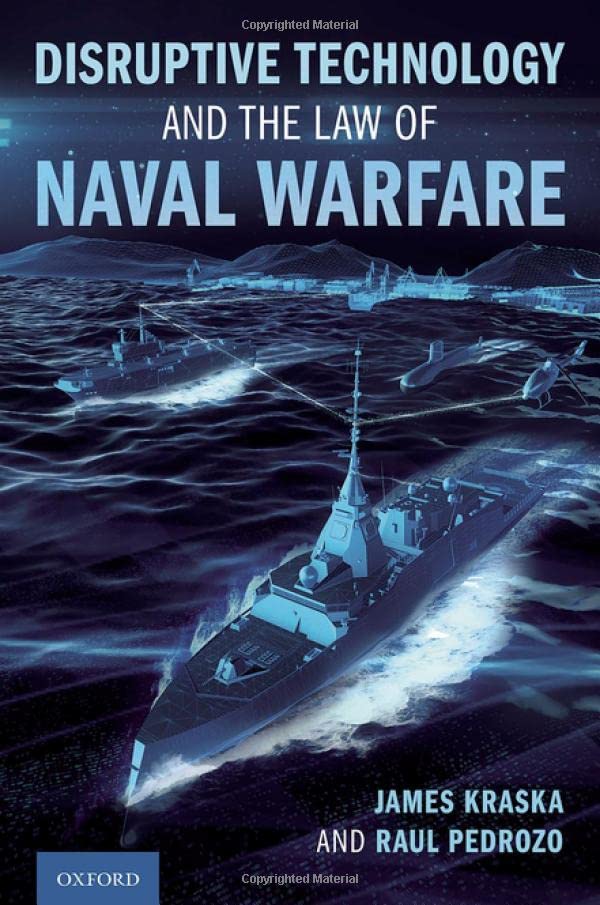
Disruptive Technology and the Law of Naval Warfare 1st edition by James Kraska, Raul Pedrozo 0197630198 9780197630198


Original price was: $50.00.$25.00Current price is: $25.00.
Disruptive Technology and the Law of Naval Warfare 1st edition by James Kraska, Raul Pedrozo – Ebook PDF Instant Download/DeliveryISBN: 0197630198, 9780197630198
Full download Disruptive Technology and the Law of Naval Warfare 1st edition after payment.
Product details:
ISBN-10 : 0197630198
ISBN-13 : 9780197630198
Author: James Kraska, Raul Pedrozo
Conflict at sea has been transformed by disruptive technologies, creating a dynamic and distributed operational environment that extends from the oceans to encompass warfare on land, in the air, outer space, and cyberspace. This raises choice of law decisions that include the law of naval warfare and the law of armed conflict, neutrality law, and the peacetime regimes that apply to the oceans, airspace, outer space, and cyberspace. The international law in networked naval warfare must contend with autonomous vessels and aircraft, artificial intelligence, and long-range precision strike missiles that can close the kill chain at sea and beyond. The asymmetrical use of merchant ships and blockchain shipping in naval operations, opening of the seabed as a new dimension of undersea warfare, and sophisticated attacks against submarine cables and space satellites pose new operational and legal dilemmas. Navigating this broader conception of the international law of naval warfare requires an understanding of emerging operational capabilities and concepts throughout the spectrum of conflict and the selection and integration of distinct legal regimes. This book gives readers an understanding of the discrete but overlapping legal frameworks connected to the law of naval warfare and explores related concepts of seapower and naval technology.
Disruptive Technology and the Law of Naval Warfare 1st Table of contents:
1. Propulsion by Oar: Rowed Galleys and Infantry Combat at Sea
2. Propulsion by Sail: Carracks, Caravels, and the Age of Discovery
3. Propulsion by Steam: Firearms and the Industrial Era
4. Revolutions in Military Affairs
5. The Rules of the Game
1. The Law of Naval Warfare and Maritime Neutrality
1. Law of Naval Warfare
1.1 Law of Naval Warfare Distinct from the Law of Armed Conflict
1.2 Law of Naval Warfare in IACs and NIACs
1.3 Restatements of the Law of Naval Warfare
2. Principles of the Law of Armed Conflict
2.1 Necessity
2.2 Military Objects
2.2.1 Effective Contribution
2.3 Proportionality
2.4 Distinction
2.5 Chivalry or Honor
2.6 Precautions in Attack
3. Weapons Review
4. Lasers and Directed Energy Weapons
5. Law of Maritime Neutrality
5.1 Neutral Territory
5.2 The Exclusive Economic Zone and the High Seas
2. Merchant Ships
1. Introduction
2. Rules That Apply to Neutral and Belligerent States
2.1 Flag State Responsibilities
2.1.1 China Maritime Militia
3. Enemy Merchant Vessels
3.1 Prize Capture
3.1.1 Armed Merchant Ships
3.2 Coastal Fishing Vessels Exempt from Capture and Attack
3.3 Belligerent Service
3.3.1 First and Second World Wars
3.3.2 Vietnam War
3.3.3 Falklands War
3.3.4 China’s Maritime Militia
3.3.5 Deception and Ruses
4. Neutral Merchant Vessels
4.1 Exempt from Attack
4.1.1 “Missile Merchants”
4.1.2 “Direct Part in Hostilities”
4.2 Exempt from Capture
4.3 Armed Neutral Ships
3. Unmanned Maritime Systems
1. Introduction
2. Legal Characterization and Status
2.1 Unmanned Aerial Systems (UAS)
2.1.1 Unmanned Aerial Systems Are “Aircraft”
2.2 Unmanned Maritime Systems (UMSs)
2.2.1 Unmanned Surface Vehicles (USV)
2.2.2 Unmanned Underwater Vehicles (UUV)
2.2.3 Naval Mines
3. Are Unmanned Maritime Vessels “Ships”?
3.1 U.S. State Practice
3.2 Can UMSs Be Warships?
3.2.1 Sovereign Immunity
3.2.2 Remote Civilian Operators and Targeting
4. Navigational Rights and Freedoms
4.1 Duties and Obligations
4. Lethal Autonomous Weapons
1. Autonomous Weapons in the “Kill Chain”
2. Compliance with LOAC
2.1 CCW Group of Governmental Experts (GGE)
2.1.1 “Ban Killer Robots”
2.1.2 Political Declaration
2.1.3 Improve Compliance with AP I
2.1.4 Apply Existing LOAC
3. Levels of Control
3.1 “Meaningful Human Control”
3.2 “Appropriate Levels of Human Judgment”
3.3 The Fruitless Quest for a Common Standard
4. Military Accountability
4.1 Command Accountability
5. Conclusion
5.1 Raising the Risk of War
5. Submarine Warfare
1. Undersea Warfare
1.1 Submarine Fleets
1.2 U.S. Submarine Forces
1.3 Russian Submarine Forces
1.4 Chinese Submarine Forces
2. The Law of Submarine Warfare
2.1 Pre-.First World War
2.2 First World War
2.3 Interwar Period
2.4 Second World War
3. Contemporary Submarine Warfare
3.1 Sinking of the INS Khukri
3.2 Sinking of the ARA General Belgrano
3.3 Sinking of the ROKS Cheonan
4. Poseidon Nuclear Drone and Environmental Modification
6. Seabed Warfare
1. Warfare from the Continental Shelf and the Deep Seabed
1.1 The Deep Seabed and the International Seabed Area
1.2 Artificial Islands, Installations, and Structures on the Continental Shelf
1.3 Seabed Arms Control Treaty
1.4 Sound Surveillance System (SOSUS)
1.5 Hydra and Upward Falling Payloads
2. Submarine Cables in Armed Conflict
2.1 The Undersea Cyber Network
2.2 Protection of Submarine Cables in Peacetime
2.2.1 1884 Submarine Cables Convention
2.2.2 1958 High Seas Convention
2.2.3 1982 Law of the Sea Convention
2.3 Tapping or Cutting Submarine Cables
2.3.1 Spanish-.American War
2.3.2 First World War
2.3.3 The Cold War
2.3.4 Submarine Cables in Great Power Competition
2.4 Submarine Cables and Cyberattack
2.5 Maritime Neutrality and Submarine Cables
2.5.1 Rights of Neutral States and Submarine Cables
2.5.2 Duties of Neutral States and Submarine Cables
7. Missile Warfare and Nuclear Weapons
1. Missile Warfare
1.1 Evolution of Strike Technology
1.2 Transition to Missiles
1.3 Missiles in Naval Warfare
1.4 Long-.Range Precision Strike
1.4.1 Cruise Missiles
1.4.2 Ballistic Missiles
1.4.3 Hypersonic Missiles
1.4.4 Conventional-.Nuclear Integration
2. Missiles as a Means of Warfare
2.1 Air Warfare Areas of Operation
2.2 Law of Air and Missile Warfare
2.3 Over-.the-.Horizon and Beyond Visual Range
3. Nuclear Missiles
3.1 Russian and Chinese Nuclear Warfighting Capabilities
3.2 Conventional-.Nuclear Integration and the INF Treaty
3.3 Legality of Nuclear Weapons
8. Naval Operations in Outer Space
1. Counterspace Operations
1.1 China Counterspace Capabilities
1.2 Russian Counterspace Capabilities
1.3 U.S. Counterspace Capabilities
1.4 Directed Energy Weapons
2. International Regulatory Regime
2.1 The Outer Space Treaty
2.1.1 Peaceful Purposes
2.1.2 Military Activities in Outer Space
2.2 The Rescue Agreement
2.3 The Liability Convention
2.4 The Registration Convention
2.5 ITU Regulations
2.6 The Moon Agreement
2.7 Draft PPWT
2.8 The Artemis Accords
3. Law of Armed Conflict in Outer Space
3.1 Restatements of Outer Space Law
3.1.1 The Woomera Manual
3.1.2 McGill Manual
People also search for Disruptive Technology and the Law of Naval Warfare 1st:
electronic warfare the forgotten discipline
naval tech during the civil war
how did the war influence later naval technology
naval technology during the civil war
disruptive technology warfare
Tags: Disruptive Technology, the Law, Naval Warfare, James Kraska, Raul Pedrozo
You may also like…

Uncategorized

Business & Economics - Management & Leadership
Politics & Philosophy - Anthropology
Lethal Autonomous Weapons: Re-Examining the Law and Ethics of Robotic Warfare Jai Galliott

Business & Economics

Jurisprudence & Law - Environmental Law
Green Criminology and the Law 1st Edition by James Gacek 3030824128 9783030824129

Education Studies & Teaching

Technique - Oil and Gas Technologies
Handbook of Gasification Technology: Science, Processes, and Applications James G. Speight

Uncategorized
History - Military History