

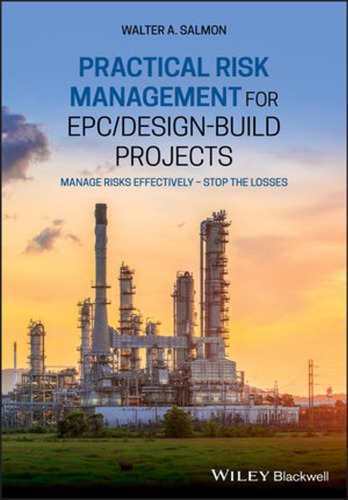
Practical risk management for EPC design build projects manage risks effectively stop the losses 1st Edition by Walter Salmon 1119596257 9781119596257

Original price was: $50.00.$25.00Current price is: $25.00.
Practical risk management for EPC/design-build projects: manage risks effectively – stop the losses 1st Edition by Walter A. Salmon – Ebook PDF Instant Download/DeliveryISBN: 1119596257, 9781119596257
Full download Practical risk management for EPC/design-build projects: manage risks effectively – stop the losses 1st Edition after payment.
Product details:
ISBN-10 : 1119596257
ISBN-13 : 9781119596257
Author: Walter A. Salmon
Many of the books on construction risk management concentrate on theoretical approaches to the accurate assessment of the overall risks of taking on a new project. Less attention is paid to the typical risks to which the operational level of a project is exposed and how operational managers should approach those risks during project implementation. This book identifies precisely where the major EPC/Design-Build risks occur within an operational framework and shows how best to deal with those risks. The book attempts to offer practical advice, approaches and tools for dealing with risks to which the various operational departments are exposed.
Practical risk management for EPC/design-build projects: manage risks effectively – stop the losses 1st Table of contents:
Chapter 1: Introduction
1.1 The Book’s Focus and Objectives
1.2 The Book’s Content and Structure
1.3 Generality of Contractual Advice Given
1.4 Common Elements for Construction Projects
Notes
Chapter 2: Construction Project Implementation Routes
2.1 Different Approaches
2.2 Traditional Contracting Approach
2.3 Design-Build Approach
2.4 EPC Approach
2.5 EPCM Approach
2.6 Employers Prefer Lump-Sum Contracts
2.7 Fixed-Price Lump-Sum Contracts
2.8 Selecting the EPC Contractor
Notes
Chapter 3: EPC Project Risk Management Overview
3.1 Project Risk Management – Definition
3.2 Construction Project Hazards Abound
3.3 Importance of Project Risk Management
3.4 Corporate Risks Versus Project Risks
3.5 Greater Risks for EPC Contractors
3.6 Principal Disaster Areas on EPC Projects
3.7 Maintaining the Project Schedule
3.8 Departmental Interface Issues
3.9 Forging an Integrated Implementation Team
3.10 Allocating Responsibility for Handling Risks
Notes
Chapter 4: EPC Project Pre-Implementation Problems
4.1 Bidding Process Pitfalls
4.2 Failure to Embrace Lessons Learnt
4.3 Failure to Understand Contract Terms
4.4 Qualifications, Deviations and Exceptions List
4.5 False Management Resourcing Plan
4.6 Underestimating the Costs
4.7 Conceptual Design Bid Pricing Problems
4.8 Agreeing to Inadequate Completion Time
4.9 Reliance on Employer’s Information/Data
4.10 Late Approval of CDVR
4.11 Gateway Between FEED and Detailed Design
4.12 Extended Review Period for Deliverables
4.13 Objecting to Impractical Review Process
4.14 Underestimating Equipment Procurement Packages
4.15 Rejection of Country of Origin
4.16 Responsibility for Governmental Problems
4.17 Performance Bond Early Submission
4.18 Requirement for On-Demand Bonds
4.19 Import Duty Responsibilities
4.20 Local Content Obligations Downplayed
4.21 Contractor’s Bid Modifications Ignored
4.22 Relying on Carrots
4.23 Square Pegs and Round Holes
4.24 Failure to Check the Margin
Notes
Chapter 5: Overseas EPC Project Preparatory Work
5.1 Critical Path Identification
5.2 Setting Up Contractor’s Administrative Systems
5.3 Determining Appropriate Management Structure
Notes
Chapter 6: Project Roles, Functions and Responsibilities
6.1 The Project Management Consultant
6.2 The Board of Directors
6.3 The Project Director
6.4 The Project Manager
6.5 The Project Controls Manager
6.6 The Project Controls Department
6.7 The Planning/Scheduling Team
6.8 The Engineering Manager
6.9 The Procurement Manager
6.10 The Expediting/Logistics Manager
6.11 The Construction Manager
6.12 The Commissioning Manager
6.13 The Operational Readiness Manager
6.14 The QA/QC Manager
6.15 The HSE Manager
6.16 The Camp Boss
6.17 The Project Information Manager
6.18 The Document Control Manager
6.19 The Information Technology Manager
6.20 The Interface Manager
6.21 The Contract Administration Team
6.22 The Human Resources Manager
6.23 The Administration Department
6.24 The Financial Management Team
6.25 The Compliance Team
6.26 The Legal Department
Notes
Chapter 7: Reducing Joint-Venture/Consortium Risks
7.1 Joint Venture Versus Consortium
7.2 JV Considerations
7.3 Setting Up a JV Steering Committee
7.4 Objectives of JV Steering Committee
7.5 JV Members are Partners
Note
Chapter 8: Claims Management Risks and Problems
8.1 Relying on Claims to Achieve Profitability
8.2 Factors Legislating Against a Claim’s Success
8.3 Key Ingredients for Worthwhile Claims
8.4 Proving Excusable Delay
8.5 Key Components of Successful Claims
Notes
Chapter 9: Identifying Hazards and Managing the Risks
9.1 Introduction
9.2 Potential Hazards for Construction Projects
9.3 Responsibility for Project Risk Assessment
9.4 Identifying and Managing Project Risks
9.5 Project Main Risks Register
9.6 Risk Assessment Team Inputs
9.7 Relative Risk Factor Assessment
9.8 Risks Arising from Safety Studies
9.9 Dealing with Safety Risks to On-Site Personnel
9.10 Dealing with Health Matters for On-Site Personnel
9.11 Dealing with Risks to the Environment
People also search for Practical risk management for EPC/design-build projects: manage risks effectively – stop the losses 1st:
often the least practical risk management technique is to
a practical risk management approach
corporate governance practical risk management
practical risk management in the construction industry pdf
practical risk management solutions
Tags: Practical, risk management, manage risks, effectively, the losses, Walter Salmon
You may also like…
Business & Economics - Management & Leadership
Business & Economics Business & Economics - Management & Leadership
Computers - Web Development
Computers - Security
Uncategorized
eTextbook 978-1118911044 Risk Assessment: A Practical Guide to Assessing Operational Risks
Business & Economics - Management & Leadership
Solving for Project Risk Management 1st edition by Christian Smart 1260473841 9781260473841
Computers - Information Systems
Medicine
Acute Stroke Management in the First 24 Hours: A Practical Guide for Clinicians 1st Edition